Discover why most enterprise AI initiatives fail at the operating layer and learn the strategic, framework-driven approach to successfully scale AI today.
To our community of data and AI leaders,
Look around the enterprise landscape right now, and you’ll see a lot of frantic motion. Everyone has access to the models, licenses are being handed out like candy, and yet, for most organizations, the needle just isn’t moving.
The data from this year tells a pretty frustrating story: while 94% of enterprises used AI last year, a staggering 79% of organizations report massive difficulties adopting it at scale today. Even worse, only about 33% of AI pilots ever make it out of the lab and into production.
Why is this happening? Because enterprise AI doesn’t break at the technology layer, it breaks at the operating layer.
I like to think that leaders aren’t just jumping at the first chance to buy licenses to Claude or whatever else, throwing them at their teams, and saying, “Make your jobs more efficient, right?” But there is so much noise and a bit of a friendly frenzy in the market right now that it’s easy to just trust the zeitgeist. Without an intentional framework, you aren’t transforming a business, you’re just sponsoring an expensive token-usage frenzy. True transformation requires stepping back, closing the door on the noise, and asking the right questions before a single trainer steps into the room.
The absolute first step for any leader depends entirely on your specific business context and what you’re actually trying to achieve. A leader in finance and banking will think about this completely differently from someone running a healthcare system or a large manufacturing plant. You have to understand what kind of business you’re in and where you actually need help to improve the operation.
You can think about improving the business in two ways:
Companies that look at this from a revenue-opportunity perspective are likely to be much more successful in the long run. Not that they won’t do the efficiency stuff too, but cost-cutting probably has a much lower ceiling than the revenue side of the equation.
We need to stop guessing and start auditing our workflows to find where AI will actually add value, rather than forcing a trendy tool into a process that doesn’t need it. Understanding and documenting the workflow is really important. It requires interviewing your people, looking closely at your data, and identifying the bottlenecks. Once you map that out, you can figure out what actually happens if you remove those bottlenecks, how it improves your operation, and, crucially, how you’re going to measure it.
We like to approach workflow automation through a practical 60-day sprint:
By breaking work down this way, you ensure you’re focusing on the fundamentals of the technology and how it intersects with processes, rather than just doing AI for AI’s sake.
It’s completely natural for team members to worry that they are training their replacement. That is a real, valid concern right out of the gate. But I like to think that AI will really help people do their jobs more effectively. As a leader, you have to create a culture and a sense of trust around, “Hey, we’re going to help you with AI,” rather than, “We’re going to remove you with AI.”
The goal here is a workforce augmentation model where the human is at the end of the loop. To maintain quality control and eliminate blind copy-pasting, you need a firm framework:
AI in the middle, human last. If a human starts a task, they’re in the loop, but we have to keep the human at the end of the loop, too. Humans need to be able to discern right from wrong. If they can’t, they don’t know the business well enough, and that’s a training problem on a whole other level.
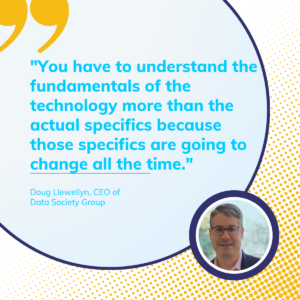
Because AI technology is evolving so rapidly, your training framework has to focus on workflows and processes rather than the technology itself. You have to understand the fundamentals of the technology more than the specific tools, because those specifics will change in two, four, or six weeks. You’ll never be able to keep up with that pace, but if you go a layer deeper, you build something that stays relevant.
The market has changed so rapidly over the last six to eight months that traditional training just isn’t working anymore, and the forecasts are frozen. Training vendors are teaching isolated skills without a strategy, and traditional strategy houses are delivering beautiful but theoretical slides.
Sustained value lives in putting together a really smart, thoughtful roadmap about how this is actually going to improve your organization. Stop trusting the zeitgeist. Build a thoughtful roadmap, prove value early with small wins, and keep your humans firmly at the end of the loop.
If you’d like to discuss implementing this kind of operating model or partner with us to build this roadmap for your leadership team, let’s connect and set up a working session.
Doug Llewellyn
CEO, Data Society
P.S. Did you catch our previously published Friday Feature? Doug’s Friday Feature: Why the Best AI Strategies for AI fluency are Built Behind Closed Doors