In this week’s Friday Feature, Doug Llewellyn shares how economic pressure is reshaping AI investment and why leaders are shifting from experimentation to focused, outcome-driven execution.
To our community of data and AI leaders,
There’s a different tone in conversations right now.
It’s not just about AI anymore. It’s about the economy. Budgets are tighter, expectations are higher, and every investment is being looked at through a much sharper lens. What used to feel like forward momentum is now being questioned for its durability, impact, and return.
And in that environment, AI is not being removed from the conversation. It’s being tested.
One of the most common assumptions is that when the economy tightens, AI investment is among the first to be cut. That is not actually what is happening. What we are seeing instead is a shift in how organizations think about where AI fits within their broader cost structure. Large, undefined AI initiatives tend to get pulled back, while more targeted, practical uses of AI often gain traction.
In many cases, leaders are not asking whether they should invest in AI. They are asking how AI can help them operate more efficiently within tighter constraints. That might mean slowing hiring and relying on AI to support existing teams, or rethinking how work gets done across functions. The focus moves from experimentation to substitution, and from exploration to efficiency.
This is where the economic pressure becomes clear.
It forces a shift from “Where can we use AI?” to “Where does AI actually change our cost structure or output in a meaningful way?”
Over the past year, many organizations have invested in AI quickly. They adopted tools, launched pilots, and encouraged teams to experiment. That made sense in a period of growth and curiosity. But in a tighter economy, that same activity is now being evaluated differently.
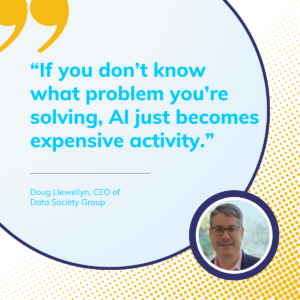
Leaders are no longer asking whether teams are using AI. They are asking whether it is contributing to business outcomes. That is a much harder question to answer, especially for initiatives that were not designed with a clear problem or metric in mind. Without that connection, even well-intentioned efforts start to feel difficult to justify.
This is where many AI initiatives begin to lose momentum.
Not because they failed, but because they were never clearly tied to what the business actually values. In a strong economy, that gap can go unnoticed for a while. In a constrained one, it becomes impossible to ignore.
One of the clearest patterns right now is how organizations are spending. There has been a tendency to overinvest in tools because it is easier to justify in the moment. The purchase is visible, the implementation is tangible, and it signals progress to the organization. But over time, many of those tools see limited adoption or unclear impact.
At the same time, investment in people, process, and decision-making has lagged behind. That imbalance becomes more obvious when budgets tighten. Leaders start to question not just what they bought, but whether their teams actually know how to use it to drive value.
Economic pressure has a way of forcing that realization.
It shifts the conversation away from access to technology and toward capability. Who in the organization can actually use AI to move the business forward? Where are the individuals or teams that can create leverage? Those become the most important investment decisions, not the tools themselves.
 Focus Becomes the Most Important Economic Strategy
In uncertain markets, focus becomes a competitive advantage. Many organizations enter the year with multiple priorities, multiple initiatives, and multiple areas of exploration. That approach becomes difficult to sustain when resources are constrained. The organizations that navigate this well tend to narrow their scope significantly.
Instead of trying to advance everything at once, they identify one or two areas that matter most to the business. They align their AI efforts directly with those priorities and measure success by whether those priorities move. That level of focus creates clarity across teams and simplifies decision-making at every level of the organization.
There is a tendency to believe that more activity will drive better results.
In a tighter economy, the opposite is often true. Reducing complexity and concentrating effort tends to produce stronger outcomes, especially when AI is involved.
If there is one question leaders are being asked more frequently right now, it is this: If you can only make one or two AI investments this year, where should they go?
The answer is not in the technology.
It starts with the business itself. What are the one or two priorities that will define success in this economic environment? Where does the organization need to preserve, protect, or grow? Once those are clear, the next question becomes whether AI can meaningfully support those outcomes.
This framing changes the role of AI entirely.
It moves from being a standalone initiative to being an enabler of something more important. And in a constrained economy, that alignment is what allows investments to hold up under pressure.
The economy has a way of forcing clarity.
It removes the space for loosely defined initiatives and replaces it with a need for focus, ownership, and measurable impact. AI is not exempt from that pressure. If anything, it is at the center.
The organizations that move forward from this moment will not be the ones that invested the most.
They will be the ones who got the clearest.
P.S. If you missed it, you can check out our last Friday Feature: From Experimentation to Expectation