In this week’s Friday Feature, Doug Llewellyn reflects on how organizations are shifting from AI experimentation to execution and what leaders should focus on instead: clear business problems, workforce capability, and measurable outcomes.
To our community of data leaders and learners,
Over the past few weeks, I’ve been in a lot of conversations about AI workforce transformation. Through CDO Magazine events, discussions inside The Data Lodge, and work with clients at Data Society, I’ve heard a wide range of perspectives. Different industries. Different roles. Different levels of maturity.
But the same question keeps showing up: Is this actually working?
Not in a demo. Not in a pilot. In the business. That question matters. Because it signals a shift. We’re no longer in the “let’s try AI” phase. We’re in the “this needs to deliver” phase.
Right now, companies are all over the map on AI ROI. Some are still in exploration mode. They want to understand the technology, experiment, and build familiarity. ROI is not the priority yet. Others are more focused. We see this often in our work at Data Society. They start with a business problem and ask where AI can actually create value.
 That distinction matters. Because the second group is already closer to an answer.
There’s also a third group trying to quantify everything. Detailed models. Productivity math. Time converted into dollars.
There’s nothing wrong with that. But here’s the reality: If you don’t start with a clear business problem, ROI becomes an academic exercise. When you do, it becomes obvious much faster.
At a recent event with the CDO Magazine community, I heard a use case that cut through the noise. A company applied AI to their SDR function.
The outcome was simple: lower cost, higher conversion and fewer manual processes.
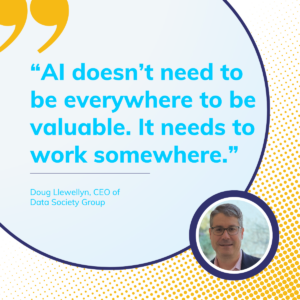
They improved lead-to-meeting conversion by about 30%. That’s not theoretical. That’s operational. And it reinforces something important: AI doesn’t need to be everywhere to be valuable. It needs to work somewhere. We’ll be continuing conversations like this at the upcoming Columbus Leadership Summit 2026 on April 16 at the Renaissance Columbus Downtown Hotel, where leaders are coming together to share what’s actually working and where AI is delivering real results—register today to join us.
Every time examples like that come up, there’s an immediate reaction: What happens to the people doing that work? It’s a fair question. But I think it’s being framed too narrowly. People in roles like SDRs build real expertise. They understand how the business works. They know how to communicate value. They know how customers think. That doesn’t go away.
What changes is where that value shows up.
We’re already seeing movement into: account management, closing roles, customer strategy and deal support. The risk isn’t AI replacing people. The risk is that organizations will not evolve their roles fast enough to keep up.
There’s been a lot of attention on how many early AI projects didn’t succeed. I think that headline misses the point. Most of those efforts were experiments. And experiments are supposed to fail. What matters is what happens next.
Across conversations in CDO Magazine forums and with organizations working with Data Society, we’re seeing a shift: more disciplined scoping, clearer ties to business outcomes, and fewer random pilots.
If the first phase was exploration, this phase is execution. And execution requires a different level of thinking.
Early AI conversations were almost entirely about technology. What tools do we need? What platforms should we invest in? That’s changing.
Now the conversation sounds more like:
We see this consistently across both Data Society engagements and peer discussions inside The Data Lodge. Technology is no longer the constraint. Capability is. If you’re thinking through how to build that capability in a way that actually shows up in day-to-day decisions, it’s worth a conversation. Donna Medeiros offers a complimentary AI advisory session to walk through your current state, where things may be stalling, and what a more practical path forward could look like
If there’s one theme that keeps coming up, it’s governance. This has been especially clear in recent CDO Magazine discussions. Not as a compliance exercise. As an operating requirement.
Without governance:
With governance:
It’s not the most exciting part of AI. But it’s quickly becoming one of the most defining.
At the practitioner level, the conversation is more grounded. Inside The Data Lodge, we hear it directly. Most teams are not asking whether AI matters. They’re asking how to make it work inside organizations that weren’t built for it. That’s a different challenge. Many of these companies are decades old. Some are over a century old. Changing how work gets done in those environments is hard.
The patterns are consistent:
Without addressing those, progress stalls.
If there’s one safe prediction, it’s this: How we measure AI success today will not hold up over the next year. The pace of change is too fast. New capabilities are being released constantly. The platforms are evolving. Expectations are shifting. So the question isn’t just: What do we know? It’s: What are we not accounting for yet? And how quickly can we adjust when the answer changes?
Across Data Society, CDO Magazine, and The Data Lodge, the signal is consistent: AI is moving forward. But organizations are starting to move differently. More focused. More practical. More grounded in outcomes. That’s a good thing. Because this next phase is not about proving AI works.
It’s about proving where it works and why.
Doug Llewellyn
P.S. If you missed it, you can check out our last Friday Feature: Your AI Strategy Might Be Too Complicated